
Students Rely on AI But Now Judge Professors Using It—That Should Make Colleges Nervous
Faculty think higher ed is a service—These four examples suggest it isn’t


I write about leadership, education, AI, and why teaching critical thinking about it is more important than ever.
Please hit the heart ❤️, restack 🔄, subscribe 📨, and all that jazz to help spread the word 🙌
Paid subscribers: Your resources for this issue are at the bottom of this article. This one includes an interactive chart tracing 40 years of cost shifting in public higher education — who was paying, what tuition actually did, and how far the Pell Grant fell behind. You can hover the data points and toggle between charts.
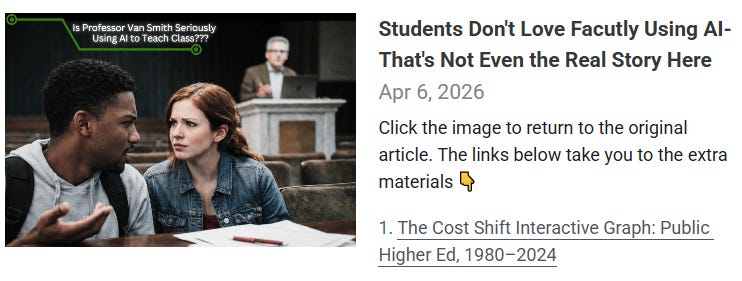
An ironic and, dare I say, delicious study came out recently asking students how they felt about faculty using AI, and what they found was an interesting little role reversal in this entire AI saga. Apparently, they weren’t all that impressed and raised some concerns. 79% questioned the validity and reliability of professors using AI to teach and grade.
That sounds a lot like students wondering whether faculty are actually checking the output before it goes out, and 37% expressed specific concerns about professors becoming over-reliant on the technology.
Seems like students are fine using AI themselves to support their own work. They’re just a lot less enthusiastic when professors start outsourcing theirs.
Think about all of this for a second, because for the last several years institutions and faculty have been the ones doing the asking. Are students using AI to write their papers? Are they actually doing the work? Is anyone in the classroom thinking for themselves? Now there is a formal study flipping that completely around, asking students to evaluate faculty behavior.
You have to admit that’s an interesting turn of events, but the more fascinating part is that a study like this exists at all.
Nobody asked us
When I was in college in the mid-90s, I had a professor, Dr. Wood, who was the chair of the psychology department, wrote the textbook on cognition, and taught a lecture course of around 300 students. On the first day, he walked in and bluntly told us not to expect an A, because most of us weren’t getting one.
Nobody liked hearing it, but we didn’t have researchers interested in asking us how we felt about it. We certainly didn’t have a student paper or any online outlet willing to question it.
If you wanted the A, you studied hard and hoped for the best. Student dissatisfaction was real, but it stayed in gripe sessions among ourselves. If you were lucky, it motivated you to prove the professor and the system wrong.
But times have definitely changed.
Example 1: Harvard and Grade Inflation
Harvard just spent five years debating grade inflation, building complicated rubrics, running committees, and deciding the percentage of A’s the institution would be allowed to give out. The reason? Because grade inflation became so obviously visible they decided it needed fixing, but then students pushed back hard, so hard, in fact, that implementation got delayed to 2027, with one student quoted as saying the proposal would create so much pressure that “life wouldn’t be worth living.”
That’s not just a reaction to a grading policy. That’s what happens when higher education spends years training students to treat grades like identity, status, and emotional life support.
And before anyone gets defensive: yes, grade inflation is a real problem, Harvard is right to address it, and they’re certainly not the only school sitting on top of this particular mess. They’re just one of the few willing to publicly admit how bad it got.
But if one of the most resourced institutions in the world needs years of committees, debate, and a complicated formula just to address something this rampant, what exactly makes anyone think colleges and universities are going to handle AI any differently?
Dr. Wood told 300 people they probably weren’t getting A’s. We showed up for the next class anyway because, well, no one would have noticed if we hadn’t.
Example 2: Kentucky doesn’t see it that way
Student opinion now carries more institutional weight than it did 20 or 30 years ago, but that change didn’t happen because colleges somehow became more democratic or more attuned to student development. State and federal aid decreased, and tuition kept climbing to offset the deficit. Branding became a survival strategy, and higher ed drifted steadily toward a customer service model.
When students started being treated like clients paying for an experience, everything downstream started moving in that direction. Grading, faculty behavior, academic rigor, and institutional policy all started getting filtered through a completely different lens. A difficult class that used to be a warning you took seriously signing up for now becomes a bottleneck and a service complaint on the way out.
And since institutions have moved toward a customer service, business-like model, states are following suit. Kentucky State Senator Gex Williams recently said unapologetically and on the record in defense of HB 490 about higher ed: “It is a business.”
He was defending a new law they’re trying to pass that would make it easier for public colleges and universities to lay off faculty and force retirements for financial reasons. Unfortunately, the spreadsheets have been saying this for years, but institutions have been sidestepping them.
The payment is now coming due.
Example 3: Promises with conditions at GVSU
At Grand Valley State University, a faculty member who retired after 30 years of service under an agreement that included bridge health insurance until Medicare is now watching that benefit get pulled while he’s in cancer treatment. In situations like these, retirements aren’t always voluntary in any meaningful sense. When the choice is to retire now or risk getting laid off, most people take the retirement. The institution gets to call it a voluntary separation while everyone is expected to quietly move on.
When an institution’s math changes, it pivots, sometimes hard. When an individual’s math changes because of a promise that institution made, they’re left to absorb that human cost. In the end, it’s starting to look more and more like it really is a business.
And if you still don’t believe me, look at what they did in Wisconsin a few years ago.
Example 4: Wisconsin found the money
UW-Oshkosh was sitting on an $18 million deficit in 2023, and the response was over 140 layoffs, 76 retirements, and the elimination of more than 35 vacant positions. By early 2026, the university was projecting a $5.3 million surplus.
That’s not a turnaround story in any feel-good sense. That’s an institution that needed money, found it in labor costs, and closed the books. And then, the day after spring commencement in 2026, more than 150 food service workers employed through vendor Elior will be laid off since the university decided not to renew the contract.
Those are cold decisions, very similar to what CEOs make in corporate settings every day.
The people who lost their jobs didn’t get a flowery mission statement. They got a separation notice and unemployed status to add to their resume. The institution that spent years describing itself in terms like student success, community impact, and educational purpose turned out to have a pretty clear hierarchy when the numbers got bad enough. Guess what? The budget won.
It’s already a business
Higher education still wants to hold onto the moral authority of mission-driven institutions. I know I certainly wanted to when I worked at the different universities I did. That framing is real, and a lot of people inside genuinely buy into it because for most of their careers it was true enough to operate from.
But this has been moving in a different direction for decades, and at this point I think it’s worth saying we’re already there. The customer model isn’t coming because it arrived years ago. The evidence isn’t even subtle: benefits get restructured after people retire on them, deficits get resolved through labor cuts, tenured faculty get easier to remove under financial pressure, and student satisfaction scores carry more institutional weight than the people working inside.
At some point you have to stop calling that service-driven and call it what it is.
The old ways are gone
The latest move is centralizing more services, which is a perfectly sensible thing for a business to do. You find redundancies, you consolidate, and you reduce costs per unit. But let me explain how this generally works in practice. Directives come down. Colleges are told they need to cut costs across the board.
Each unit is handed a percentage of costs and staff they need to cut, to achieve it. Positions that aren’t seen as urgent don’t get filled. One of the easiest ways to reduce faculty costs is to get people to retire. They’re given generous incentives to do just that. It’s usually not based on what departments they’re in, but years of service.
Do you see where I’m going here? You end up with incredibly uneven decisions that aren’t strategically aligned with educational needs. This is the part where it almost stops feeling like a business and starts feeling like institutional panic, because the execution is less surgical and more of a means to an end.
You have to wonder how long it is going to be before they centralize teaching and course design with standard delivery. They’ll need a much smaller number of people to actually do it while the institution scales the product. If you think that sounds far-fetched, you’re probably still operating from the old contract and the pre-AI era.
© 2026 Bette A. Ludwig: All rights reserved
Paid Subscriber Resources
Paid subscribers can find this in the subscriber resource library
Your access link was included in your welcome email. If you can’t find it, check your spam folder or send me a direct message here on Substack or LinkedIn and I’ll send the link again.
The Cost Shift: Public Higher Ed 1980 to 2024: This interactive chart traces 40 years of cost shifting in public higher education — who was paying, what tuition actually did, and how far the Pell Grant fell behind. You can hover the data points and toggle between charts.

@Dr Sam Illingworth I thought you might find this article interesting!